Talooner splits into two halves that never share secrets: an ephemeral CI runner that talks to your forge, and a self-hosted cluster that holds the rules and the model credentials. The runner extracts facts and executes actions; the cluster does all the reasoning. Same commit, same rules, same verdict — every time.
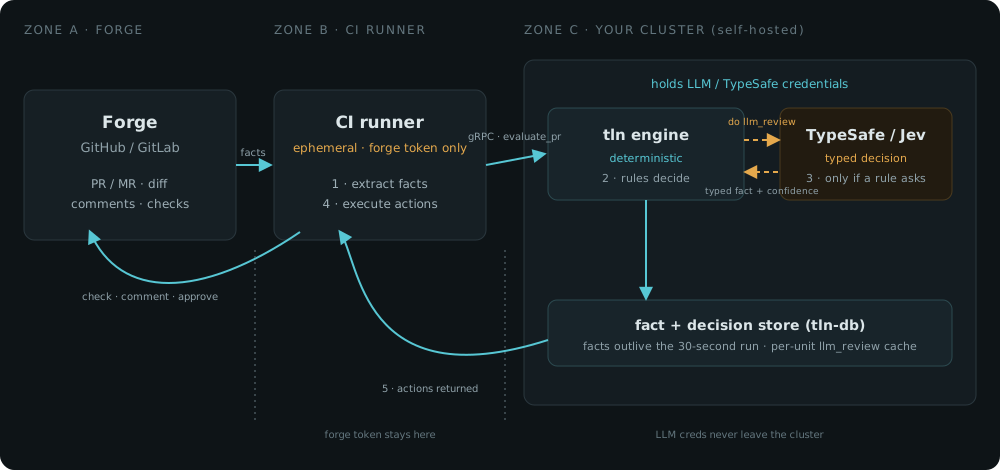
The flow, step by step
- Trigger. A PR/MR event fires, or a maintainer comments
!talooner /review. - Extract facts. The ephemeral runner reads the forge API with its scoped
token:
pr.*,user.*,review.*, the diff, changed files, CI status. - Evaluate. Facts cross to the cluster over gRPC (
evaluate_pr). Thetlnengine loads the repo's ruleset and resolves the verdict. Most PRs never touch a model. - Consult a model — only if a rule asks. Where a rule says
do llm_review, the executor calls a model with the code-unit's state plus a typed question. With TypeSafe / Jev that answer comes back as a typed decision with calibrated confidence — aChoice, aScore, or aNoul(true/false, 0–1) — which re-enters the engine as an ordinary fact (llm.risk,llm.risk_confidence, …). Not prose. - Act. The engine returns a list of actions; the runner executes them on the forge — a check run / commit status, one sticky review comment, an advisory approve/block, assignees and review requests — then exits.
Works with your agents
Talooner reviews the pull request, not the tool that wrote it — so it fits whatever your team already uses to write code. Native integrations are on the way.
Runs on
Reviews PRs from
Autonomous loops coming soon —
tools that code unattended overnight (Flow-Next's Ralph mode, agent task runners) produce
exactly the "insurmountable wall of pull requests" no reviewer can read. Talooner can be their
last gate: the loop asks talooner rules plan --repo … --pr … before it hands off, sees
"needs security review" or "blocked: too large", and fixes it before a human ever looks.
Because the author is just a fact, a rule can treat agent-written PRs differently:
rule "Agent-authored PRs get an owner review" {
  for records where type == "pr" and attr "pr.author" ends_with "[bot]"
  requires "review.owner"
  do assign "pr" attr "user.owner"
  do comment "pr" "Opened by {attr.pr.author} — the code owner signs off before merge."
}
Why this shape
- The credential boundary is the whole point. The runner holds only a scoped, short-lived forge token. The model credentials live in the cluster you run, so every token a rule spends is billed to whoever ran the rule. Nobody's review load lands on someone else's API limits.
- Typed output makes confidence a first-class gate. A rule can act on a high-confidence verdict and escalate to a human on a low one — something you can't express cleanly against free-text LLM output.
- Determinism where it counts. The engine is deterministic. The single
probabilistic hop is isolated behind
do llm_reviewand cached per code-unit, so its variance is contained rather than driving the verdict.